Shopify vs WooCommerce in Israel (2026): Which Platform for Your Store?
By Daniel Mashkov, AI Systems ArchitectPublished Updated 9 min read
TL;DR
Neither platform wins by default for an Israeli store. The honest answer depends on five things — catalog size, Israeli payment gateways, your maintenance budget, whether you already run WordPress, and your 5-year revenue plan. Shopify is the hands-off choice: it runs itself, and you pay a monthly plan plus a fee on every sale, because Shopify Payments is not available in Israel. WooCommerce is the control choice (cheap to host, but it needs a developer). I am not loyal to either — I help you pick the one that fits the business, and increasingly I use AI to build and run whichever you land on faster and cheaper than the manual way.
Market snapshot 2026
Five years ago the question had an easy answer: Shopify was the polished cloud platform, WooCommerce was the budget DIY option. That is no longer true. WooCommerce grew up — managed hosting, mature payment integrations, and a serious extension marketplace. Shopify, meanwhile, has pushed harder into mid-market and enterprise. The result is two genuinely capable platforms that solve the same problem from opposite directions.
There is no reliable public figure for how Israeli stores split between the two — global trackers such as BuiltWith and W3Techs rank both among the most-used store platforms, and neither number is specific to Israel. Store owners divide along one line — those who want simplicity and zero maintenance, and those who want control and lower running costs. That split, not a feature checklist, is what should drive your decision.
Shopify vs WooCommerce — Israel 2026
| Factor | Shopify | WooCommerce |
|---|---|---|
| Code ownership | Limited | Full |
| Speed to launch | Very fast | Moderate |
| Monthly cost | $39–$399 + 0.6%–2% per sale | Hosting + gateway fees |
| Customization | App-limited | Unlimited |
| Built-in support | 24/7 | Via a dev |
Shopify: simplicity at scale
Shopify is fully managed. You pick a theme, add products, and it handles hosting, security, the CDN, and backups. No server to babysit, no database to tune, no 2 a.m. "the site is down" calls. For an owner who wants to sell — not to run infrastructure — that is the whole pitch, and it is a strong one.
The cost is predictable but not small. Shopify's plans are $39, $105 and $399 a month on monthly billing (less when paid yearly), and Shopify Plus starts at $2,300 a month. Because Shopify Payments is not available in Israel, every sale also carries Shopify's third-party transaction fee — 2% on Basic, 1% on Grow, 0.6% on Advanced — on top of what your Israeli gateway and acquirer charge, and most stores add a few paid apps. As revenue climbs, the plan fee shrinks as a share of sales; the per-sale fees do not.
Best for: owners who value convenience over control and have no technical staff. If your catalog and checkout are standard and you do not want to think about servers, Shopify earns its keep — as long as you have priced in the per-sale fee, which grows with your revenue.
WooCommerce: control and flexibility
WooCommerce is self-hosted: you own the server, the database, and the data. You can customize anything, connect to any API, and you are never locked into one vendor's roadmap. The running cost is hosting — Midrag's price guide puts hosting and a domain for a WordPress site at ₪14–₪160 a month (checked October 2026), and a managed host sized for a store with real traffic costs more (Kinsta's entry managed plan, for example, is $35 a month) — plus your payment processor's fees. No platform fee on every sale.
The catch is real: someone has to maintain it. Plugins update, databases bloat, and an unpatched site is a target. Budget for regular developer time — a few hours a month for a simple store, more for one with many plugins or custom integrations — or put it on a managed WooCommerce host that handles much of the patching for you. This is exactly the part AI changes most — I use AI-assisted tooling to catch structural issues early and keep maintenance hours down.
Best for: businesses already on WordPress, stores that need custom logic (B2B pricing, complex catalogs, deep CRM/inventory sync), and anyone allergic to platform lock-in. If your store has to talk to other systems in your business, WooCommerce gives you the room to make that happen.
The five decision factors
Weigh these five factors for your specific store. For the gateway one, the Israeli payment gateway picker shows which providers work on each platform.
- Catalog size. Shopify does not cap the number of products on any plan, has allowed up to 2,048 variants per product since late 2025, and scales the infrastructure for you. WooCommerce has no hard cap either, but a catalog in the tens of thousands of products needs deliberate work: good hosting, object caching and a proper search. Big, fast-moving catalogs lean Shopify unless you have engineering behind the WooCommerce build.
- Israeli payment gateways. On WooCommerce every major Israeli gateway has a plugin — Cardcom, Hyp and PayPlus on WordPress.org, Tranzila and Grow supply their own. On Shopify you choose from Shopify's list for Israel (Grow, Hyp, PayPlus, Tranzila PayTech, iCount, plus PayPal) and pay Shopify's third-party fee on top. If your business already has a gateway agreement, check it is on that list before you pick Shopify.
- Maintenance budget. Shopify needs almost no server upkeep — though theme and app changes still cost developer time. WooCommerce needs recurring developer time but saves the platform fees. If you have the budget and the volume, WooCommerce wins on the math; if you do not, Shopify is cheaper in practice.
- Existing WordPress infrastructure. If you already run WordPress for your site or content, WooCommerce adds ₪0 in platform cost — it lives on the same stack. Shopify is a separate platform with separate logins, costs, and data. This one factor often settles the decision on its own.
- The 5-year view. Shopify's per-sale fee grows with revenue: at ₪2M a year, the third-party fee alone is about ₪12,000 on Advanced (0.6%) and ₪40,000 on Basic (2%), before gateway fees. WooCommerce hosting grows with traffic, not with revenue. If you genuinely expect to scale past ₪2M, the long-term economics favor WooCommerce — provided you invest in maintaining it properly.
Checkout control: edit or only extend
With WooCommerce the checkout is your code. You can add fields, change the steps, or rebuild the flow — in PHP on the classic checkout, or with blocks on the newer block checkout. With Shopify you extend the checkout through Shopify's checkout extensibility: apps and extensions that add blocks and logic at points Shopify defines. You cannot rewrite the core flow, and extensions inside the information, shipping and payment steps are a Shopify Plus feature.
For a standard store that difference never shows. For B2B pricing, an approval step, deposits, or a checkout that has to write into an Israeli ERP in real time, it is often the factor that decides the platform — and it is cheaper to find out before the build than after it.
Integration, extensibility, and where AI changes the picture
Shopify has thousands of apps, and you can also build a custom app against its API — but you always work within the hooks and limits Shopify exposes. Connecting to an Israeli accounting system or an older CRM can hit a wall if neither an app nor the API covers what you need. WooCommerce draws on the whole WordPress plugin library and — crucially — lets you change the code itself, so order-to-Airtable sync, a webhook on every purchase, or a bespoke inventory bridge are all on the table.
This is where the platform debate matters less than it used to. Most of the real work in a store is the plumbing between it and the rest of your business — leads, orders, inventory, accounting. I build that automation layer on either platform, increasingly with AI agents doing the routing and reconciliation. So the better question is not "Shopify or WooCommerce?" but "which one lets me automate your specific business fastest?" — and I will give you a straight answer for your case, not a sales pitch for the platform I happen to prefer.
Which platform should you choose?
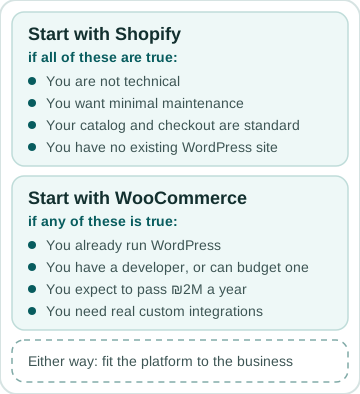
Start with Shopify if you are non-technical, want minimal maintenance, your catalog and checkout are standard, and you have no existing WordPress site. The simplicity is genuinely worth the fee for most small and mid stores.
Start with WooCommerce if you already run WordPress, you have (or can budget) a developer, you expect to pass ₪2M/year, or you need real custom integrations. The long-term economics and the freedom are better — and with AI-assisted maintenance the old "WooCommerce is a hassle" objection is much weaker than it was. Either way: choose the platform around the business, not the other way around.
Shopify vs WooCommerce for an Israeli store — at a glance
| Factor | Shopify | WooCommerce |
|---|---|---|
| Hosting & maintenance | Fully managed — almost no server upkeep | Self-hosted — needs recurring developer time |
| Monthly cost | $39–$399/mo (Plus from $2,300) | Hosting: ₪14–₪160/mo per Midrag; more for managed store hosting |
| Transaction fees | Shopify's 0.6%–2% third-party fee + gateway and clearing fees | Gateway and clearing fees only — no platform fee |
| Israeli gateways | Shopify's Israel list: Grow, Hyp, PayPlus, Tranzila PayTech, iCount | All major Israeli gateways, via plugins |
| Checkout | Extend only (step extensions need Plus) | Fully editable |
| Customization & integrations | Apps, or a custom app via the API — within Shopify's limits | Custom code — any API |
| Catalog scale | No product cap; up to 2,048 variants per product | No hard cap; large catalogs need tuning |
| Best for | Non-technical owners, minimal maintenance, standard catalog and checkout | WordPress users, custom logic, >₪2M/yr |
FAQ
Is Shopify still worth it in 2026?
For many Israeli stores, yes — if you want a managed platform and your catalog and checkout are standard. The trade-off is fixed: Shopify Payments is not available in Israel, so every sale carries Shopify's third-party fee (2% on Basic, 1% on Grow, 0.6% on Advanced) on top of your gateway, plus a plan of $39, $105 or $399 a month on monthly billing. If you already run WordPress, need deep custom integrations or expect high revenue, WooCommerce usually costs less over five years.
How much does Shopify take from a $100 sale?
In Israel, where Shopify Payments is unavailable, Shopify itself takes its third-party fee: $2 on Basic, $1 on Grow, $0.60 on Advanced. Your payment provider takes its share on top. With Grow (the Israeli provider, formerly Meshulam) on its standard plan, that is 0.75% plus its 0.6% surcharge for Shopify stores — $1.35, before VAT. So a $100 sale costs about $3.35 on Basic, $2.35 on Grow and $1.95 on Advanced, plus VAT on the provider's fee, ₪2.50 per transaction if 3D Secure is on, and the monthly plan fees. Prices checked October 2026.
Does Shopify work in Israel?
Yes. Israeli businesses run Shopify stores and sell in shekels; what is missing is Shopify Payments, which is not available in Israel. You take cards through a provider on Shopify's list for Israel — Grow, Hyp, PayPlus, Tranzila PayTech or iCount — add PayPal for buyers abroad, and Shopify charges its third-party transaction fee on each sale.
Is it better to use WooCommerce or Shopify?
Neither by default. Shopify is better when you want no server upkeep, have no developer and run a standard catalog and checkout. WooCommerce is better when you already run WordPress, need custom logic or deep integrations with Israeli systems, or expect revenue high enough that Shopify's per-sale fee outweighs the cost of maintenance. I build on both — see WooCommerce development in Israel and Shopify store development in Israel.
Can I migrate from Shopify to WooCommerce later?
Yes, with some effort. You export your catalog and orders from Shopify as CSV and import them into WooCommerce; you lose any Shopify-specific theme customizations and apps. For a standard store, plan for roughly one to two weeks of developer work. The other direction is harder: moving from WooCommerce to Shopify means re-implementing every customization inside Shopify's limits, so budget more time for it. I have done these migrations both ways — the data moves cleanly, the design and integrations are the real effort.
Is WooCommerce secure enough for credit cards?
Yes — when you use a payment processor (Tranzila, Cardcom, Grow) and never store card numbers on your own server. The processor tokenizes the card and you keep only a reference; with the processor's hosted payment page or fields, card data never touches your server, which keeps your PCI scope small. The rest of the site's security — updates, passwords, plugins — is yours to get right, where on Shopify the platform handles it.
Can I run WooCommerce without a developer?
For the first setup and the catalog upload, yes. For updates, performance and the day a plugin conflicts with another, you need one — or a managed WooCommerce host that takes the routine patching off your hands. Managed hosting reduces the work; it does not remove it.
What if my WooCommerce store gets hacked?
Prevention first: almost all WordPress vulnerabilities are found in plugins and themes, so keeping them updated — plus off-site backups you have actually tested restoring — is the main defense. A managed WooCommerce host (Kinsta, SiteGround, or similar) applies platform patches for you and usually includes daily backups and security monitoring; Kinsta's entry plan, for example, starts at $35 a month. If you are hacked anyway, restore from a clean backup, update everything, and change every password and key.
Sources
- Shopify — plans and third-party transaction fees
- Shopify Israel — plans and third-party provider fees (checked 2026-10-03)
- Grow — published fees incl. the 0.6% Shopify surcharge (checked 2026-10-03)
- Shopify Payments — supported countries (Israel is not one)
- Shopify — payment providers for Israel
- Shopify — checkout extensibility
- Shopify — checkout UI extensions (information, shipping and payment steps are Plus-only)
- Shopify — product variant limit raised to 2,048
- WooCommerce documentation
- Kinsta — WordPress hosting plans (checked 2026-10-03)
- Midrag — website building price guide, incl. hosting & domain (checked 2026-10-03)
- Patchstack — State of WordPress Security
Related services
Related reading
June 2026 · 7 min
Tranzila vs Cardcom vs Meshulam (Grow): Israeli Payment Gateways Compared
May 2026 · 7 min
WooCommerce CRM Integration Guide for Israeli Stores 2026
May 2026 · 7 min
WooCommerce Checkout Abandonment: What's Actually Killing Your Conversions
October 2026 · 11 min
Moving a Store Between Shopify and WooCommerce: What Transfers, What Does Not, and How to Keep Your SEO