Tranzila vs Cardcom vs Meshulam (Grow): Israeli Payment Gateways Compared
By Daniel Mashkov, AI Systems ArchitectPublished Updated 7 min read
TL;DR
Of the three, only Grow (formerly Meshulam) publishes a price: 0.75%–1% per transaction plus ₪29–₪69 a month, before VAT, clearing fee included. Tranzila and Cardcom quote per business, and the clearing fee is negotiated. Choose by platform (Cardcom is not on Shopify's list for Israel), recurring billing and when the money reaches you. Checked October 2026.
Tranzila vs Cardcom vs Grow (Meshulam) — at a glance, October 2026
| Factor | Tranzila | Cardcom | Grow (Meshulam) |
|---|---|---|---|
| Published price | Tranzila: No — by quote | Cardcom: No — by quote | Grow (Meshulam): ₪29–₪69/month + 0.75%–1% (before VAT) |
| Clearing fee | Tranzila: Negotiated (Tranzila is also a licensed acquirer) | Cardcom: Negotiated (Cardcom is also a licensed acquirer) | Grow (Meshulam): Included in the plan |
| Recurring billing | Tranzila: Built-in | Cardcom: Built-in | Grow (Meshulam): Built-in (standing orders) |
| WooCommerce | Tranzila: Tranzila's own plugin | Cardcom: Official plugin on WordPress.org | Grow (Meshulam): Grow plugin, ₪299 one-time |
| Shopify (Israel) | Tranzila: Listed (Tranzila PayTech) | Cardcom: Not in Shopify's Israel list | Grow (Meshulam): Listed (+0.6%) |
| When you get paid | Tranzila: By agreement (Express: weekly or monthly) | Cardcom: By agreement | Grow (Meshulam): From the 1st of the next month |
| Best for | Tranzila: Stores that want to settle both parts with one provider | Cardcom: WooCommerce stores with a developer | Grow (Meshulam): Small stores that want a visible price |
Need Bit, installments, invoices or a marketplace split as well? The Israeli payment gateway picker checks nine providers against your platform and needs, with a source for every answer.
Gateway fee vs clearing fee: what you actually pay
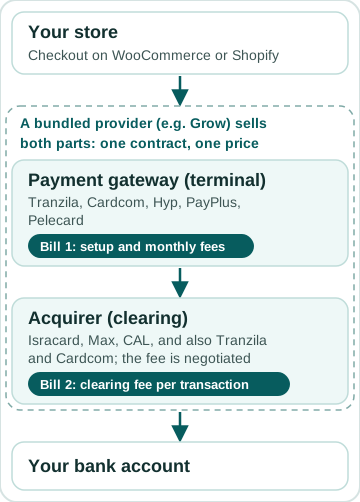
Most comparisons of Israeli payment providers mix two different bills. The gateway — the terminal your WooCommerce or Shopify store talks to, such as Tranzila, Cardcom, Hyp (the company behind Yaad Sarig), PayPlus or Pelecard — charges its own setup and monthly fees. The clearing fee on every transaction is charged by the acquirer: Isracard, Max or CAL, and also Tranzila and Cardcom, which each hold their own acquirer license from the Bank of Israel (Tranzila since 2017; Cardcom's became permanent in 2023).
The clearing fee is negotiated between your business and the acquirer — Tranzila says so on its own site — which is why no one can honestly publish "Tranzila charges 1.9%". The only official figures come from the Bank of Israel, and they are old: for 2016 it reported an average merchant fee of 1.01%, with small businesses paying 1.49% and large ones 0.84%. Treat that as the shape of the market (small stores pay more per transaction), not as a quote.
A bundled provider sells both parts as one product. You sign one agreement, the money passes through the provider's account, and the price is published. In Israel that is Grow, and it is the main reason small stores pick it.
Published per-transaction rates, October 2026 (before VAT)
Published prices (checked October 2026)
Grow publishes two plans. Grow: 0.75% per transaction, ₪59 a month on an annual plan or ₪69 month to month, with 100 transactions and 100 documents included. Grow Light: 1% per transaction, ₪29 a month billed annually, with 20 transactions and 20 documents included. Past the included quota, each extra transaction or document costs ₪0.50 on Grow and ₪1 on Grow Light. No setup fee. Extras: 3D Secure adds ₪2.50 per transaction, payments through Shopify add 0.6%, tourist cards cost 3.5%, and the WordPress plugin is a one-time ₪299. All prices exclude VAT.
Tranzila, Cardcom, Hyp, PayPlus, Pelecard and Z-Credit publish no price list for online stores — every one of them works on a quote. Tranzila's site shows "from ₪29 a month", but that figure is for its mobile-clearing product, not a website terminal. If someone quotes you a "standard" rate for any of these, it is their own deal, not a public price. iCredit (Rivhit's clearing product) does publish a list: setup ₪99–₪150 plus VAT depending on the clearing route, and monthly packages from ₪69 plus VAT.
Two international names come up in every conversation and neither replaces a local gateway. Stripe does not support businesses registered in Israel, and Shopify Payments is not available in Israel. PayPal works: its published Israeli commercial rate is 3.40% + ₪1.20 per domestic transaction before VAT, with more for international payments — useful as an extra button for buyers abroad, expensive as your only option.
Tranzila: gateway and acquirer in one company
Tranzila is one of the oldest Israeli gateways and has held its own acquirer license from the Bank of Israel since 2017 (made permanent in 2024). It has built-in recurring billing (Tranzila Recurring, for card and bank standing orders), phone support from 8:30 to 20:00 including Fridays, and WhatsApp support. It charges in shekels or dollars; other currencies need prior setup with the card companies.
For WooCommerce, Tranzila supplies its own plugin (it is not on WordPress.org). On Shopify it appears in Shopify's list of payment providers for Israel as "Tranzila PayTech". How fast you get paid depends on your agreement; its Express route pays out weekly or monthly, your choice. Pricing is by quote, so ask for the monthly terminal fee, the clearing rate at your expected volume, and the cost of 3D Secure — separately.
Cardcom: the WooCommerce regular
Cardcom started as a gateway and, by its own account, is now an acquirer as well: it lists a permanent acquirer license from the Bank of Israel in 2023 and sells clearing, the terminal and invoices under one agreement. As an acquirer it clears Visa, Mastercard, Isracard and Diners; its site marks American Express as "coming soon", so ask about it if your customers pay with Amex. It has built-in recurring billing (by card or bank standing order), is certified PCI-DSS Level 1, and offers phone support. The Cardcom WooCommerce plugin is the most installed Israeli gateway plugin on WordPress.org (about 3,000 active installs), which in practice means most WooCommerce developers have already connected it.
The Shopify caveat: Cardcom says it has a Shopify app, but at the start of October 2026 it was still not in Shopify's own list of payment providers for Israel. If you are on Shopify, confirm with Cardcom in writing that the integration is live for new stores before you sign. Pricing is by quote.
Grow (formerly Meshulam): one contract, published price
Grow launched in 2013 as Meshulam, a way to pay building-committee fees by credit card, and later rebranded as Grow. It sells clearing as a bundle: you do not sign separately with a credit-card company, and the prices above are the whole transaction fee. It also issues documents (invoices and receipts) inside the plan, supports recurring billing through standing orders, and has a developer API.
The trade-off is cash flow. Money you receive sits in your Grow account and becomes available from the 1st of the following month. On the 9th, an available balance above ₪50,000 is transferred to your bank automatically; below that you move it yourself, up to ₪15,000 a day. During the month a free credit line lets you use part of the money early: 25% of the month's turnover or ₪10,000, whichever is lower. For a store that lives on weekly supplier payments, that delay still matters more than the percentage. On Shopify, remember the extra 0.6%.
Hyp and PayPlus: the other two with Shopify support
Hyp (Yaad Sarig is now "by Hyp") and PayPlus are both in Shopify's list of providers for Israel and both have official WooCommerce plugins on WordPress.org. Both are gateways with quote-based pricing, so the same rule applies: get the terminal fee and the clearing rate as separate numbers, in writing.
How to choose
Start from your platform and your cash flow, not from a percentage. The percentage you will actually pay is negotiated, and at small volumes the fixed monthly fees and extras (3D Secure, document fees, platform surcharges) often cost more than the difference between two clearing rates.
- Small store, want one contract and a price you can see today: Grow — if a monthly payout works for you.
- WooCommerce store with volume to negotiate: get quotes from Cardcom and Tranzila (and Hyp or PayPlus), each with a separate clearing rate.
- Shopify store: stay inside Shopify's Israel list — Grow, Hyp, PayPlus, Tranzila PayTech, iCount — and add PayPal only for buyers abroad.
- Subscriptions or memberships: all of Tranzila, Cardcom and Grow support recurring billing; ask how failed renewals are retried and how card tokens are stored.
FAQ
Can I use Stripe in Israel?
Not with an Israeli business. Israel is not on Stripe's list of supported countries, and Shopify Payments is not available in Israel either. Use a local gateway, and add PayPal if you sell abroad.
Which payment method is available in Israel?
Cards come first: Visa, Mastercard and Israel's own Isracard, usually with the option to split a purchase into equal installments, which Israeli shoppers expect. Next to cards, Israeli gateways offer Bit, Apple Pay and Google Pay — Grow lists all three — and PayPal works as an extra button for buyers abroad. Stripe and Shopify Payments are not available. Which of these you can offer depends on your gateway, so ask each provider for its list before you sign. I set these up on WooCommerce stores in Israel.
Can I switch processors later?
Yes. For a one-off-purchase store it is mostly a plugin swap and a round of test transactions. Subscriptions are the hard part: stored card tokens usually cannot move to a new provider unless both providers arrange a transfer, so plan for customers re-entering their cards, and budget a week or two of testing.
Do I need an accountant to set up processor reporting?
Not to set it up. Every provider here exports transactions and settlement reports that your bookkeeper can import, and Grow and iCredit also issue invoices and receipts inside the plan. Ask your accountant which document format they want before you choose.
What's the minimum monthly volume to use each processor?
None of them publishes a minimum. What changes with volume is what matters: at a few thousand shekels a month the fixed fees dominate, so compare the total monthly cost at your real volume, not the percentage alone.
Can I have a custom-designed payment page?
Yes, within limits set by how the card form is connected. A hosted payment page is the provider's own page: you get whatever branding its settings allow, so ask each provider what you can change, and your PCI burden stays the smallest. An embedded page puts the provider's form inside your checkout in an iframe: everything around the card fields is yours to design, the fields still come from the provider, and you must keep that page free of scripts that could tamper with it. Full control over the card fields themselves means a direct API integration, which brings a much longer PCI questionnaire and a developer to maintain it. For most stores the embedded page is the sensible middle. The details are in my guide to connecting card payments to a website in Israel.
What about UPay?
I did not include UPay in this comparison. On its own site it describes itself as a credit-card clearing system for businesses, with a payment page, standing orders, Bit payments and free invoices, and it publishes no price list. The UPay page for e-commerce modules says the module fits WordPress, Joomla and Magento and connects to the site's shopping cart; it does not name WooCommerce or Shopify there. If you are considering it, ask UPay for its WooCommerce plugin and how updates are delivered, check Shopify's list of payment providers for Israel if your store is on Shopify, and get the terminal fee and the clearing rate as separate numbers, in writing — the same as with the others. Checked 3 October 2026.
Sources
- Grow — published fees, payout terms (checked 2026-10-03)
- Grow — recurring billing (standing orders)
- Grow — company history (Meshulam, 2013)
- Tranzila — FAQ (support hours, currencies)
- Tranzila — recurring billing
- Tranzila — the clearing fee is negotiated with the acquirer
- Tranzila Express — weekly or monthly payout
- Cardcom — company history, acquirer license, card brands (checked 2026-10-03)
- Cardcom — Shopify app
- WordPress.org — Cardcom plugin (3,000+ active installs, checked 2026-10-03)
- Bank of Israel — permanent acquirer license for Cardcom (July 2023)
- iCredit — price list (checked 2026-10-03)
- Bank of Israel — acquirer license for Tranzila, 2016 average merchant fees (April 2017)
- Bank of Israel — permanent acquirer license for Tranzila (2024)
- Shopify — payment providers for Israel (checked 2026-10-03)
- Shopify Payments — supported countries
- Stripe — supported countries
- PayPal Israel — merchant fees (checked 2026-10-03)
- UPay — products: payment page, standing orders, Bit, invoices; no published prices (checked 2026-10-03)
- UPay — modules for e-commerce sites: WordPress, Joomla, Magento (checked 2026-10-03)