Will AI Replace Web Developers? What Business Owners Actually Need to Know
By Daniel Mashkov, AI Systems ArchitectPublished Updated 6 min read
TL;DR
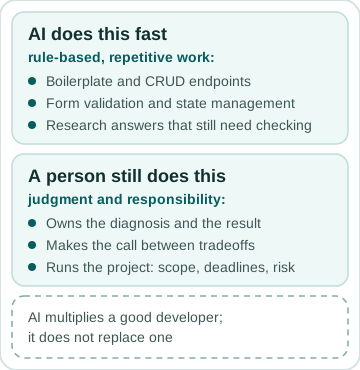
AI has made routine coding fast and cheap, but the evidence on speed is mixed: in a controlled GitHub study, developers with Copilot finished a small, well-defined task 55% faster, while a 2025 METR trial found experienced developers working in their own large codebases were 19% slower with AI tools — and in February 2026 METR wrote that developers are probably faster with the newer tools, though its follow-up could not measure by how much. What AI does not do on its own is decide why your WooCommerce checkout fails, design a payment flow you can trust, or make the calls that turn a website into a revenue engine. For a business owner the practical takeaway is simple: AI multiplies a good developer; it does not replace one. A small business is better served by one strong developer who uses AI well than by three juniors without it, and an agency that ignores AI tooling will fall behind.
What is AI actually good at?
AI excels at mechanical coding tasks. Boilerplate, CRUD endpoints, form validation, state management — rule-based, repetitive work. A developer using Claude Code (or Cursor, or Copilot) finishes these much faster than by hand.
AI also speeds up research: "What's the best way to handle Shopify API rate limits?" or "How do I improve LCP in Next.js?" It answers in seconds, with code and references — which still need checking, because a confident answer can be out of date or simply wrong.
What an automation pipeline looks like
Trigger
WhatsApp / form / email
AI layer
understands intent
Route
Make.com / n8n
CRM + action
logged, replied, booked
What can't AI do (yet)?
AI cannot own a diagnosis. A customer reports "my checkout is broken." Given access, an AI agent can read logs, run commands and propose a fix — and that genuinely helps. But someone has to decide what access it gets, tell a real cause from a plausible one, weigh the fix against everything else running on the store, and answer for the result. Debugging production is a large share of professional work, and it is exactly where a confident wrong answer costs the most.
AI cannot judge. "Should we cache this query?" "How many microservices is too many?" "Is this architecture safe at 10M users?" These are judgment calls that come from experience. AI can lay out the tradeoffs — it cannot make the call.
AI cannot run a project. Client communication, deadlines, scope negotiation, risk assessment — human skills. A client who says "I need a store that makes me ₪100K/month" needs a person to ask "Which products? What margins? What does it cost to acquire a customer?" and map a realistic path.
The business reality: cheaper to build, still needs a builder
With AI, a good developer builds a working store (catalog, checkout, emails, integrations, custom code) noticeably faster than before, and that saving reaches the client as a lower cost or a shorter timeline. The developer is still needed: the tools write code quickly, but deciding what to build and checking that it is right is still human work.
The market is adjusting. Developers who work well with AI tooling can deliver faster and often for less, and clients are starting to expect that. For a developer, the main risk is not being replaced; it is standing still. This is exactly how I work: AI-assisted, so you get senior judgment at a faster pace.
What should a business owner do now?
If you run a small business with a web presence: don't try to build it in-house with AI. Hire one strong developer (not three juniors) equipped with AI tooling. You'll ship faster and pay less than the old way.
If you're a freelance developer or an agency: invest in AI tooling and modern infrastructure. It is table stakes now. Clients expect faster delivery, and AI is how you meet that without burning out or cutting corners.
Never hire on "a junior who'll grow into a senior." Hire on problem-solving ability. In 2026 a developer with a few years of experience who works well with AI is worth far more than a junior without it.
The long view: where development goes from here
In 3–5 years, "coding" as we know it may shrink, but "development" will expand. More businesses will have digital products; more products will be custom. The need for developers who understand architecture, user needs, and business logic only grows.
But that developer will code far faster, think deeper, and charge differently — not for lines of code, but for outcomes and systems.
FAQ
Should I learn to code if AI does it for me?
Yes, if you plan to run a product or business that depends on software. You don't need to be an expert coder, but understanding how systems work, where the bottlenecks are, and what tradeoffs exist makes you a better leader. AI amplifies knowledge; it doesn't replace it.
Will freelance rates keep dropping as AI gets better?
For commodity work, the pressure is real: a study of a large freelance platform (Hui, Reshef and Zhou, Organization Science) found that after ChatGPT launched, freelancers in the most exposed categories got fewer jobs and earned less — top-rated freelancers included. Work that AI does not do alone — diagnosis, architecture, owning the outcome — is where I expect rates to hold. Templated sites and simple integrations keep getting cheaper; strategic work does not.
What coding languages will stay in demand?
Languages that solve business problems, not theoretical ones. JavaScript, Python, Go, and Rust are safe bets. Language choice matters less than knowing a framework deeply (Next.js, Django, Rails). AI doesn't care which language you write in — it will help in any of them; what matters is that you can tell when it is wrong.
Sources
- Peng et al. — The Impact of AI on Developer Productivity: Evidence from GitHub Copilot
- METR — Measuring the impact of early-2025 AI on experienced open-source developer productivity
- METR — We are changing our developer productivity experiment design (February 2026)
- Hui, Reshef & Zhou — The Short-Term Effects of Generative AI on Employment (Organization Science)
- Anthropic — Claude