Freelancer or Agency: The Honest Answer (From a Freelancer)
By Daniel Mashkov, AI Systems ArchitectPublished 5 min read
TL;DR
For small and mid-size projects, you are usually paying agency overhead (account managers, project coordinators, office rent) rather than senior talent. A good freelancer delivers the same output for noticeably less than an agency. Agencies win on availability (they can staff five projects simultaneously) and continuity (if your contact leaves, there is a bench). Choose freelancer for focused, one-off work; agency for ongoing, multi-concurrent projects.
The Overhead Hidden in Agency Pricing
An agency quote pays for more than the person doing the work: the account manager and project overhead, the engineer or designer doing the actual work, the back office (accounting, HR, payroll), and the agency's profit. A freelancer with the same skill level carries only their own time plus a thin layer of overhead (accounting software, insurance, maybe a part-time assistant). The talent cost is the same; the overhead is not.
This is not a flaw in agencies. It is a feature. Agencies can absorb a developer suddenly leaving mid-project. Agencies can batch ten concurrent clients into one team. Agencies can negotiate enterprise insurance and data compliance at scale. But if you have one project, one timeline, and clear requirements, that overhead is pure waste.
When Freelancers Stumble
A freelancer cannot cover five projects at once. If your needs are "I need someone on retainer who can drop everything for an urgent fix," an agency is the better bet. Agencies maintain bench capacity for exactly this reason.
Second: freelancers have lives. Illness, family, burnout — these are real risks. An agency has payroll staff whose job is to cover vacancies. If your freelancer disappears for two weeks and does not respond, you have no recourse.
Third: knowledge loss. If the freelancer is the only person who knows your codebase or design system, and they move on, you are stranded. Agencies document more (not always better, but more), so handoffs are possible.
The Quality Question
The best freelancers are senior people who got tired of office politics and wanted more control over their time and clientele. The worst are people who could not hold a job at an agency and hung out a shingle to survive. Same range exists in agencies — the best are world-class teams; the worst are junior staff billing at senior rates because of the agency brand.
The difference: interviewing a freelancer, you talk directly to the person doing the work. Interviewing an agency, you talk to a sales person; your actual contact may be different (and often lower-ranked than you expect). Freelancers have higher variance in skill but complete transparency. Agencies have lower variance but higher opacity.
How to Make the Right Choice
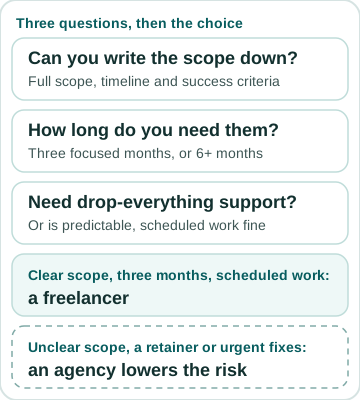
Ask yourself: (1) Can I describe the full scope, timeline, and success criteria in writing? (2) Do I need the same person for 6+ months, or just 3 months focused work? (3) Will I need reactive "drop everything" support, or is predictable, scheduled work fine?
If (1) is yes, (2) is "3 months," and (3) is no: freelancer. If any of those flip — unclear scope, long-term retainer, reactive needs — an agency de-risks the bet.
FAQ
What if the freelancer ghosts me?
Protect yourself: (1) Use a written contract. Make it short — one page — but include kill fee if they abandon. (2) Tie payments to milestones instead of paying everything upfront — a deposit to start is normal. (3) Require weekly standups, even if brief. (4) Ask for references from recent clients and actually call them. A freelancer who has ghosted once will ghost again.
Can I hire an agency for just one project?
Yes, but it costs more for one project because the agency cannot amortize overhead across five concurrent clients. They will quote as if it is a solo engagement (usually higher than if you were a retainer client). If you need a one-off, a senior freelancer is usually cheaper and faster. Agencies are built for retainers and repeating work.
What if I need both? A freelancer AND an agency?
Smart move for larger projects. Hire the freelancer for specialized work (e.g., performance optimization, custom integrations) and the agency for ongoing support and project management. This gives you the cost savings of freelance talent plus the managed continuity of an agency. Just be clear on scope boundaries so the two don't step on each other.
Related services
Related reading
April 2026 · 7 min
8 Red Flags When Hiring a WordPress Developer (Before You Sign Anything)
May 2026 · 6 min
How Much Should a Website Cost in 2026? Real Numbers
January 2025 · 4 min
The Hidden Cost of "Good Enough" WordPress Development
October 2026 · 10 min
Building a Website for Your Business in Israel (2026): What to Decide Before You Start