AI Automation Readiness for Israeli SMBs: Are You Ready to Automate?
By Daniel Mashkov, AI Systems ArchitectPublished Updated 8 min read
TL;DR
Automation amplifies what you already have — good processes become faster; bad ones become faster disasters. An Israeli SMB should evaluate readiness through five concrete indicators: payment infrastructure maturity, WhatsApp integration readiness, data cleanliness, team buy-in, and a documented process — then run a three-month "cleaning phase" that determines whether automations last or collapse in six months.
Why does automation fail in chaotic businesses?
The number one reason automation projects fail in Israeli SMBs is not technology — it's that the underlying business process was broken to start with. If your sales team manually tracks leads in three different spreadsheets and a messaging app, automating the "lead intake" step will only create faster chaos: data conflicts, duplicates, and lost records distributed twice as fast.
Automation is a force multiplier. Good processes multiply. Bad ones do too. The hard truth is that you cannot automate your way out of a management problem.
What an automation pipeline looks like
Trigger
WhatsApp / form / email
AI layer
understands intent
Route
Make.com / n8n
CRM + action
logged, replied, booked
The Five Readiness Indicators
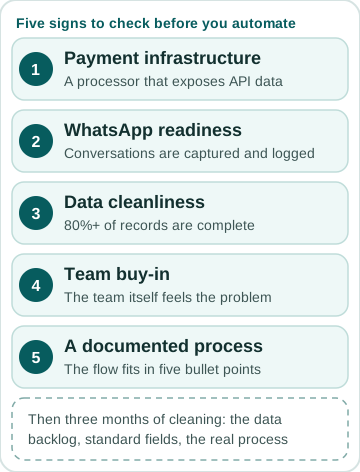
Evaluate readiness against five concrete indicators before you automate anything:
- Payment infrastructure maturity: Does your business use a professional payment processor (Cardcom, Tranzila, PayPal) that exposes API data, or is it still cash-in-hand and manual entry? Automation that doesn't touch real payment data is theater.
- WhatsApp readiness: In Israel, WhatsApp is the default channel customers use to reach a business. If your team is not capturing and logging WhatsApp conversations, automating them is impossible. If you are, you have the foundation for intent-based routing and bot integration.
- Data cleanliness: Audit your core dataset — customer records, orders, invoices. Do 80%+ of records have complete required fields (name, contact, payment method)? If less than 60% are complete, the automation will spend much of its time handling exceptions instead of doing the work.
- Team buy-in: Talk to the people who will use it. If a team member says "this is just more work" or "I've seen three automations fail," that's a signal to validate the pain point first, not to bulldoze the automation through.
- Process documentation: Can you write down the current flow in five bullet points? If you can't, the team does not have consensus on what "the process" even is. Automation requires that clarity.
The Three-Month Cleaning Phase
Before automating, spend three months addressing data backlog, standardizing field entries, and documenting the real (not ideal) process. This is the boring part. It is also the part that determines whether your automation succeeds or becomes an orphan after six months.
A practical test: grab a random week of recent data. Run the automation logic by hand. If you encounter five "wait, how do we handle this?" moments, the process is not ready. If you encounter one, you are close.
How to Start Small
Choose one high-frequency, low-stakes workflow: order confirmation replies, receipt sending, or lead acknowledgment. Something that happens 5+ times per week but does not block the business if it fails temporarily. Run it for two months; measure time saved and error rate. This teaches the team what automation looks like and builds confidence before tackling complex workflows.
FAQ
Do I need to hire a developer to set this up?
Not for the first automation. Tools like Zapier, Make, and n8n cover most common SMB workflows without code. You only need custom development when you hit the edge cases: complex business logic, proprietary payment flows, or when you have 50+ transactions per day and need sub-second latency. Start tool-first; develop second.
What if the automation breaks mid-process?
That's why you start small. Choose workflows where a failed automation just means "send the customer a manual reply instead." Set up error notifications (Slack, email) so you know instantly. A good automation should fail audibly and safely, not silently. If it fails silently (and you don't notice for a week), your process was too isolated from human oversight.
How do I know if I should hire external help?
Hire help when (a) you've spent two months on process cleaning and still have 30%+ bad data, (b) your team lacks bandwidth to own the cleanup, or (c) you are at the three-month mark and need to scale to 3+ workflows in parallel. A good consultant will validate your readiness before offering a solution — they should ask hard questions about data quality and process consensus, not just say "yes, let's automate that." For a quick self-check before that conversation, try the AI readiness score.
Related services
Related reading
May 2026 · 12 min
Automation for Small Businesses in Israel (2026): What to Automate First, Which Tools, What It Costs
May 2026 · 9 min
AI Automation for Your Business: What Actually Works (and What Gets Abandoned)
May 2026 · 9 min
WhatsApp Bot for Business in Israel: What It Does, What It Costs, and Who Should Build One